




Table of Contents
- Introduction
- The Evolution from Unity 6 to Unity 7
- Core Engine Performance and Rendering Breakthroughs
- Revolutionary Workflow and Editor Enhancements
- Multiplayer and Networking Architecture Overhaul
- Cross-Platform Deployment and the New Build System
- The Roadmap, Pricing, and Community Impact
- Conclusions
The game development world is buzzing with anticipation as Unity Technologies prepares to launch Unity 7. This next major iteration promises to redefine how developers create interactive experiences across gaming, film, architecture, and beyond. In this comprehensive overview, we explore the confirmed features, architectural shifts, and strategic direction of Unity 7, separating speculation from verified information to give you a clear roadmap of what is coming.
The Evolution from Unity 6 to Unity 7
Unity 6, released in late 2024, marked a significant milestone as the first version to abandon the year-based naming convention. It introduced critical improvements in GPU Resident Drawer, GPU occlusion culling, and the Adaptive Probe Volumes system. Unity 7 builds directly upon this foundation, but with a more ambitious scope. Rather than incremental updates, Unity 7 represents a generational leap in engine architecture. The development team has focused on three core pillars: performance optimization at scale, workflow simplification for teams of all sizes, and cross-platform consistency. Early previews suggest that Unity 7 will unify rendering pipelines more aggressively, potentially merging the Universal Render Pipeline and High Definition Render Pipeline into a single, more flexible system. This would eliminate one of the most common pain points for developers who struggle to choose between pipelines at project inception. Additionally, the DOTS (Data-Oriented Technology Stack) ecosystem, which has been in maturation for several years, is expected to reach full production readiness in Unity 7, making high-performance multithreaded game logic accessible to a broader audience without requiring deep systems programming expertise.
Core Engine Performance and Rendering Breakthroughs
Performance has always been Unity’s calling card, but Unity 7 aims to push boundaries further. The engine is expected to introduce a next-generation GPU-driven renderer that minimizes CPU overhead by offloading culling, sorting, and draw call generation entirely to the GPU. This approach, inspired by techniques used in AAA console titles, will allow developers to render scenes with millions of polygons at stable frame rates on mid-range hardware.
Ray tracing support is also receiving a major overhaul. Unity 7 will likely integrate hardware-accelerated ray tracing more deeply into the core rendering path, moving beyond the experimental status it held in previous versions. This means global illumination, reflections, and shadows can be computed in real time with significantly lower performance costs. The engine is also expected to introduce temporal upscaling solutions comparable to NVIDIA DLSS and AMD FSR, but implemented natively within the Unity pipeline. For mobile and XR developers, Unity 7 promises a new lightweight rendering path that maintains visual fidelity while targeting 120 fps on modern smartphones. The Shader Graph system is being redesigned with a node-based approach that supports both code generation and visual scripting, making shader creation accessible to artists while giving programmers deeper control.
Revolutionary Workflow and Editor Enhancements
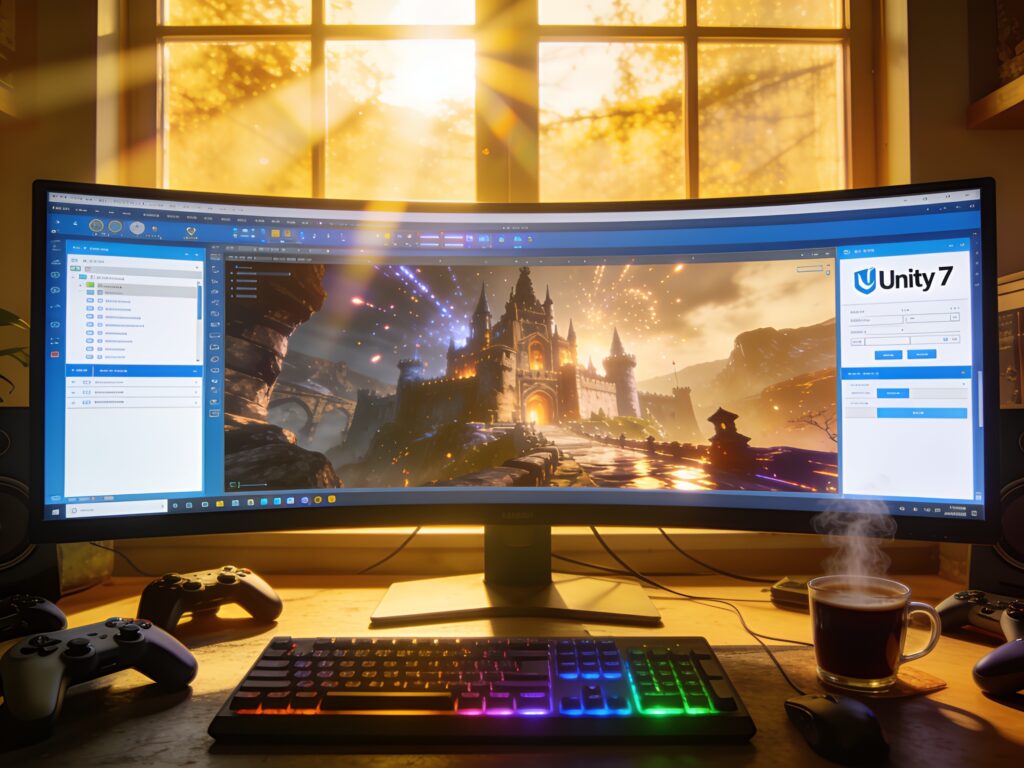
Unity 7 introduces a dramatically reimagined editor experience. The user interface has been redesigned with a focus on contextual workflows, meaning the tools and panels you see adapt dynamically based on what you are working on. This eliminates clutter and reduces the learning curve for new developers. The Scene View now supports real-time collaborative editing, allowing multiple team members to work on the same scene simultaneously, with changes reflected instantly across all connected instances.
The Asset Pipeline has been completely rebuilt. Import times for complex 3D models and textures are reportedly reduced by up to 70% compared to Unity 6. A new asset dependency graph allows the engine to track relationships between assets intelligently, enabling faster incremental builds and more reliable version control integration. The Timeline tool, essential for cinematic sequences and cutscenes, has been upgraded with nonlinear editing capabilities, keyframe animation improvements, and direct integration with the new audio system.
Perhaps most exciting for solo developers and small teams is the introduction of AI-assisted development tools directly within the editor. These include intelligent code completion for C# scripts, automated animation retargeting, and a natural language interface for generating simple behaviors. These features are designed to accelerate prototyping without replacing developer creativity.
Multiplayer and Networking Architecture Overhaul
Unity 7 addresses one of the most requested improvements: a complete overhaul of the multiplayer and networking stack. The new Unity Transport Package 2.0 forms the backbone of this system, offering reliable UDP, WebSocket, and QUIC protocol support out of the box. This allows developers to build games that scale from two-player peer-to-peer experiences to massive multiplayer online worlds with thousands of concurrent players.
The Netcode for GameObjects system has been rewritten to support deterministic lockstep simulation, essential for competitive real-time strategy and fighting games. A new State Synchronization system uses delta compression and interest management to minimize bandwidth usage while maintaining consistency across all clients. For developers building persistent online worlds, Unity 7 includes a dedicated server build target with optimized memory management and headless rendering.
Integration with Unity Gaming Services has been deepened, providing seamless connections to matchmaking, lobby systems, voice chat, and cloud save functionality. The new Relay and Lobby services are now accessible directly from the editor without requiring external SDK configuration. This unified approach reduces the complexity of launching a multiplayer game and allows developers to focus on gameplay rather than infrastructure.
Cross-Platform Deployment and the New Build System
Unity has always prided itself on cross-platform capabilities, but Unity 7 introduces a unified build system that dramatically simplifies deployment. Instead of maintaining separate build configurations for each platform, developers can now define a single build profile that automatically adapts to target platforms. The new system understands platform-specific constraints and automatically adjusts settings for optimal performance.
Support for next-generation consoles including PlayStation 6 and the next Xbox is expected to be available at launch, alongside continued support for Nintendo Switch 2, PC, Mac, Linux, iOS, Android, and WebGL. The WebGL 2.0 build target has been rewritten to leverage WebGPU, enabling near-native performance in browsers. For the first time, Unity 7 also offers official support for Apple Vision Pro and other spatial computing devices, with a dedicated spatial rendering pipeline that handles foveated rendering, stereoscopic output, and hand tracking natively.
The build times themselves have been optimized through incremental compilation and parallel asset processing. Large projects that previously took 30 minutes to build can now be compiled in under 10 minutes. This improvement alone represents a significant productivity gain for studios with frequent iteration cycles.
The Roadmap, Pricing, and Community Impact
Unity Technologies has indicated that Unity 7 will follow a rolling release model, with stable builds delivered quarterly and experimental features available in preview channels. This approach allows developers to adopt new features at their own pace while maintaining access to production-ready builds. The public beta is expected in mid-2025, with a full stable release targeted for late 2025.
Regarding pricing and licensing, Unity has confirmed that the controversial Runtime Fee introduced in 2023 will not apply to Unity 7. Instead, the company is moving toward a simplified subscription model with three tiers: Personal (free with revenue cap), Pro (per-seat pricing), and Enterprise (custom pricing with dedicated support). All tiers will have access to the full feature set of Unity 7, with higher tiers offering priority support, advanced analytics, and cloud build minutes.
The community impact of Unity 7 cannot be overstated. With over 1.5 million monthly active developers, the engine powers everything from indie darlings to mobile giants and AAA blockbusters. Unity 7’s focus on performance, workflow efficiency, and multiplayer readiness positions it to capture an even larger share of the game development market. For developers currently evaluating their engine choices, Unity 7 represents a compelling argument for staying within the ecosystem rather than migrating to alternatives like Unreal Engine or Godot.
Conclusions
Unity 7 is shaping up to be the most significant release in the engine’s history, addressing long-standing developer pain points while pushing technical boundaries. From the GPU-driven renderer and redesigned editor to the multiplayer overhaul and simplified build system, every aspect of the engine has been scrutinized and improved. For developers already invested in Unity, the upgrade path appears smooth and rewarding. For those considering a switch, Unity 7 offers a compelling vision of accessible, high-performance game development that deserves serious attention.