








Table of Contents
- Introduction
- The Structure and Significance of the Nvidia-Groq Agreement
- Groq’s Technological Innovations and Their Appeal to Nvidia
- Financial Implications and Stakeholder Benefits
- Talent Acquisition and Organizational Impact
- Regulatory Considerations and Market Competition
- Future Prospects and Industry Impact
- Conclusions
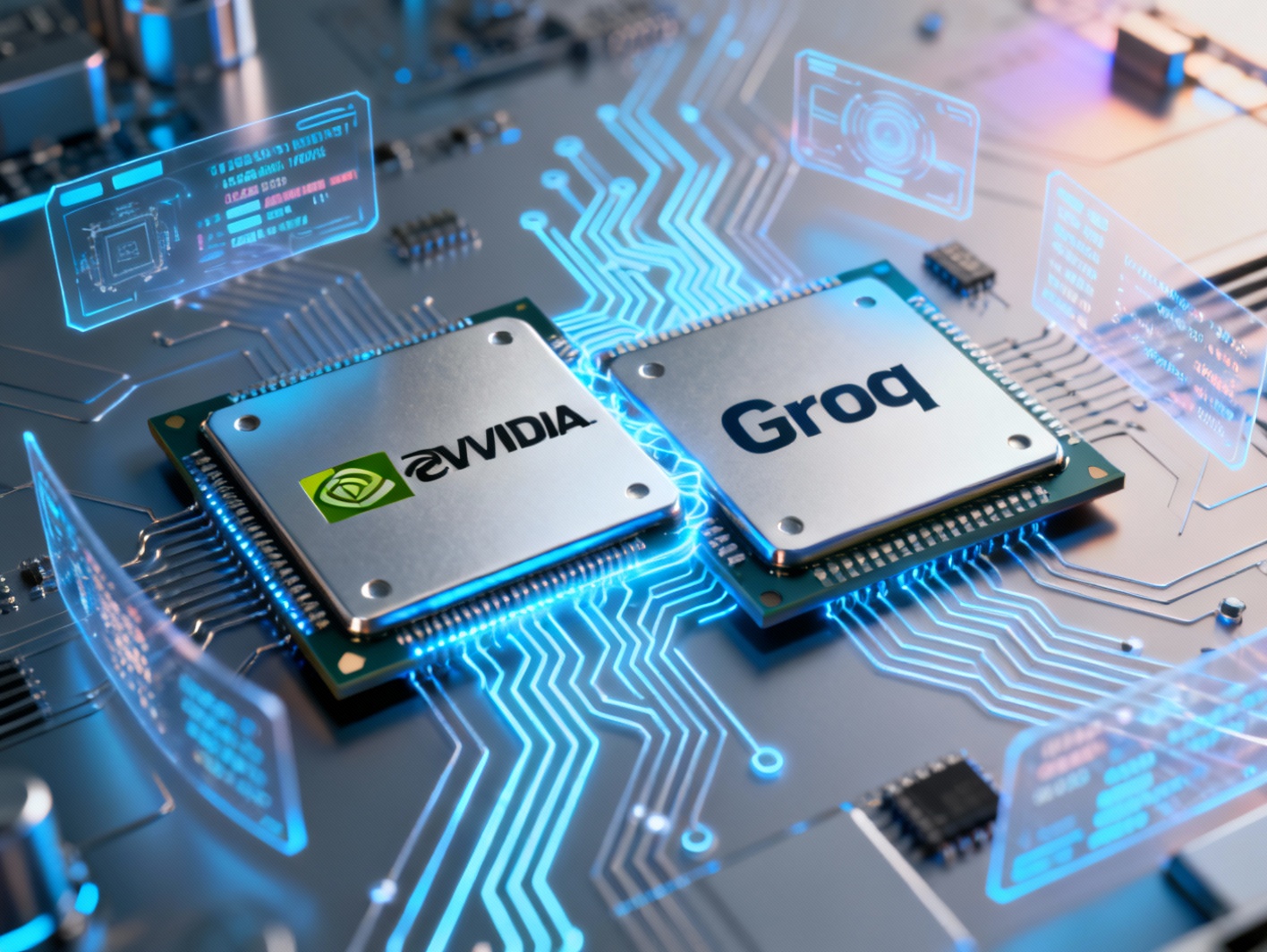
Nvidia’s groundbreaking $20 billion licensing agreement with Groq marks a transformative step in the evolution of artificial intelligence hardware. Rather than acquiring Groq outright, Nvidia has entered into a non-exclusive partnership that enables access to Groq’s advanced inference technology while preserving Groq’s independence. This collaboration brings together Nvidia’s industry-leading GPUs with Groq’s deterministic compute architecture, which is optimized for AI workloads. The strategic nature of this deal promises to significantly boost Nvidia’s inference capabilities, offering a notable advantage in real-time AI processing. At the same time, it reshapes the competitive landscape by emphasizing the value of low-latency solutions in the booming AI sector.
The Structure and Significance of the Nvidia-Groq Agreement
The $20 billion non-exclusive licensing deal between Nvidia and Groq is centered around the licensing of Groq’s inference-specific technology to enhance Nvidia’s AI capabilities without an outright acquisition. One of the most notable elements of the agreement is that Groq will remain an independent company. However, Groq’s founder Jonathan Ross and president Sunny Madra will transition to Nvidia, signaling a deep integration of intellectual and human capital. Under new leadership, Groq will continue developing its LPU lineup. Nvidia’s move allows it to gain access to Groq’s unique architecture and accelerate its progress in inference performance without triggering regulatory complications associated with acquisitions. This strategy is particularly important in the context of growing demand for specialized AI hardware that performs inference tasks more efficiently. By licensing rather than acquiring, Nvidia gains flexibility, and Groq retains autonomy — a win for both parties as they navigate the accelerating AI landscape.
Groq’s Technological Innovations and Their Appeal to Nvidia
Groq’s technology centers on its custom-built Language Processing Unit (LPU), which is designed for deterministic, low-latency AI inference rather than training tasks. The LPU architecture fundamentally differs from traditional GPUs in that it uses a single pipeline with predictable execution, eliminating performance variability. This is particularly advantageous in real-time AI applications where latency and response time are critical, such as autonomous driving, robotics, and real-time translation. One of Groq’s most distinct features is its SRAM-based memory design, which minimizes access time compared to DRAM used in most GPUs. This memory approach not only reduces latency but also increases energy efficiency by cutting down on data transfer-related overhead. For Nvidia, this complements their GPUs, which are optimized for training large AI models but are less efficient at running them in production. Integrating Groq’s deterministic architecture adds new dimensions to Nvidia’s inference product line, enabling it to offer a more comprehensive hardware suite that spans training and inference. The synergy between GPUs and LPUs allows Nvidia to cover a broader range of AI use cases more efficiently.
Financial Implications and Stakeholder Benefits
Groq’s $20 billion valuation in this licensing deal highlights both the strategic importance of its technology and the confidence Nvidia places in its future potential. Financially, the deal is structured to distribute value across Groq’s stakeholders, including investors, employees, and founders. Shareholders benefit from a massive return on investment, especially those who backed Groq in its early funding rounds. Employees, many of whom hold equity or stock options, also stand to gain substantial financial compensation, ensuring continued motivation and alignment with Groq’s mission. Importantly, the licensing approach provides Groq ongoing revenue through continued technological development rather than a one-time acquisition payout. For Nvidia, spreading payments over time and tying them to licensing performance may alleviate immediate financial pressure while still securing long-term benefits. The deal sets a new benchmark for AI hardware valuation and reflects investor enthusiasm for companies building purpose-built AI chips. By choosing a licensing model over a purchase, both firms can pursue financial and technological growth independently while maintaining a deeply collaborative relationship.
Talent Acquisition and Organizational Impact
The deal’s human dimension is marked by the movement of top talent from Groq to Nvidia. Jonathan Ross, Groq’s founder, and Sunny Madra, its president, are joining Nvidia to lead efforts in inference-related research and development. This talent transfer signifies more than just staffing changes; it infuses Nvidia with deep expertise in building and scaling deterministic AI hardware systems. Ross brings experience from both Google’s TPU team and Groq, providing a rare blend of corporate and startup innovation in semiconductor design. Madra contributes years of experience bridging technology development with business execution. With this infusion of senior leadership, Nvidia is expected to accelerate its roadmap for inference hardware and tailor new solutions that combine GPU and LPU capabilities. Organizationally, Groq will install new leadership to maintain its independent operations, which ensures continuity in its business focus. Meanwhile, Nvidia benefits substantially, as it gains not just technology but the minds behind it. The human capital involved is instrumental in keeping Nvidia at the forefront of AI innovation, especially as talent scarcity becomes an industry-wide challenge.
Regulatory Considerations and Market Competition
By structuring the agreement as a non-exclusive licensing deal rather than a full acquisition, Nvidia avoids the regulatory scrutiny that large M&A transactions often attract, especially in markets where it already holds a dominant position. This is particularly relevant in the AI hardware domain, where Nvidia’s leadership in GPUs puts it under constant observation by antitrust agencies. The licensing model allows Nvidia to integrate Groq’s LPU technology and personnel without triggering competitive concerns. For Groq, remaining independent ensures its clients, including potential Nvidia competitors, can still use its hardware without fear of vendor lock-in. This enhances competitive parity while enabling scalability. In a market increasingly filled with custom chip startups and tech giants like Google, Amazon, and Apple investing in their inference chips, the Nvidia–Groq partnership balances competition and innovation. Nvidia positions itself as a leader open to collaboration, which may encourage broader industry alliances while staving off regulatory pressure. Structurally, this arrangement may increasingly become a model for future deals in the AI space where exclusivity could stifle innovation or provoke antitrust concerns.
Future Prospects and Industry Impact
Looking ahead, the Nvidia-Groq agreement is likely to accelerate advancements in AI inference technology. By combining Nvidia’s scale and ecosystem with Groq’s fast, deterministic hardware, future AI systems may achieve new standards in responsiveness and efficiency. Advancements could include the development of hybrid systems that utilize both GPUs and LPUs, optimizing workloads dynamically across architectures. This integration could benefit edge and enterprise applications that demand real-time performance, such as augmented reality, financial modeling, and industrial automation. Nvidia may also expand its CUDA and TensorRT ecosystems to support LPU implementations, making it easier for developers to adopt the combined stack. In the broader industry, this partnership signals a shift toward specialized hardware as the next frontier in AI performance innovation. Other companies may follow suit, investing in or partnering with startups that excel in targeted segments like inference, memory efficiency, or energy consumption. Nvidia-Groq thus sets a precedent, demonstrating how strategic alliances—rather than consolidations—can yield breakthrough innovations and preserve competitive dynamics in a fast-moving market.
Conclusions
Nvidia’s strategic agreement with Groq is more than just a licensing deal—it’s a deliberate move to drive the next generation of AI inference capabilities. By combining Groq’s ultra-efficient, low-latency hardware with Nvidia’s technological infrastructure and scale, both companies are set to redefine real-time AI performance. The collaboration also highlights a smart approach to innovation through partnership, avoiding regulatory entanglements while still achieving deep integration. As AI evolves rapidly, this partnership reflects an important industry trend: the move toward specialized, interoperable technologies that make artificial intelligence faster, more reliable, and more accessible. The implications are profound—for developers, investors, and the AI ecosystem at large. With this deal, Nvidia not only reinforces its leadership position but also shapes the direction of AI hardware innovation for years to come.