








Table of Contents
- Introduction
- The Discovery: A Cryptic Message Leads to the Desert
- Unveiling the Monument: A Closer Look at the Structure
- Community Theories: Deciphering the Statue’s Origins
- Marketing Masterstroke: The Impact on The Game Awards Hype
- The Role of Alternate Reality Games (ARGs) in Modern Marketing
- Awaiting Revelation: What to Expect at The Game Awards 2025
- Conclusions
A strange statue has been discovered in the Mojave Desert, sending shockwaves through the gaming community just months ahead of The Game Awards 2025. What began as a cryptic social media post from Geoff Keighley quickly evolved into a full-blown internet mystery that led fans into the desert sun. The buzz surrounding this ominous monument has sparked theories, speculation, and a renewed excitement for what surprises the upcoming event may unveil. This is an immersive marketing experience unlike any the industry has seen before—one that blurs the line between reality and game fantasy.
The Discovery: A Cryptic Message Leads to the Desert
Everything began when Geoff Keighley posted a puzzling message on X (formerly Twitter)—three peculiar words: ‘regal.inspiring.thickness’. Accompanied by a cryptic image depicting a shadowy silhouette in the middle of a dusty landscape, the post sent social media into overdrive. This wasn’t just random wordplay. Gaming enthusiasts quickly realized this phrase was a geolocation pointer from the What3Words system, a geocoding app that assigns three-word combinations to locations on Earth. With fevered excitement, fans discovered that the coordinates pointed to a remote section of the Mojave Desert.
Once the location spread online, groups of curious adventurers and content creators took the journey into the desert. The rough terrain and heat didn’t deter them—many were inspired by the idea that this was a teaser for a major announcement at The Game Awards. The use of What3Words added an element of digital treasure hunting to the experience, engaging fans in an interactive puzzle that set the tone for what was to come. The gaming community was on high alert: something big was waiting to be revealed.
Unveiling the Monument: A Closer Look at the Structure
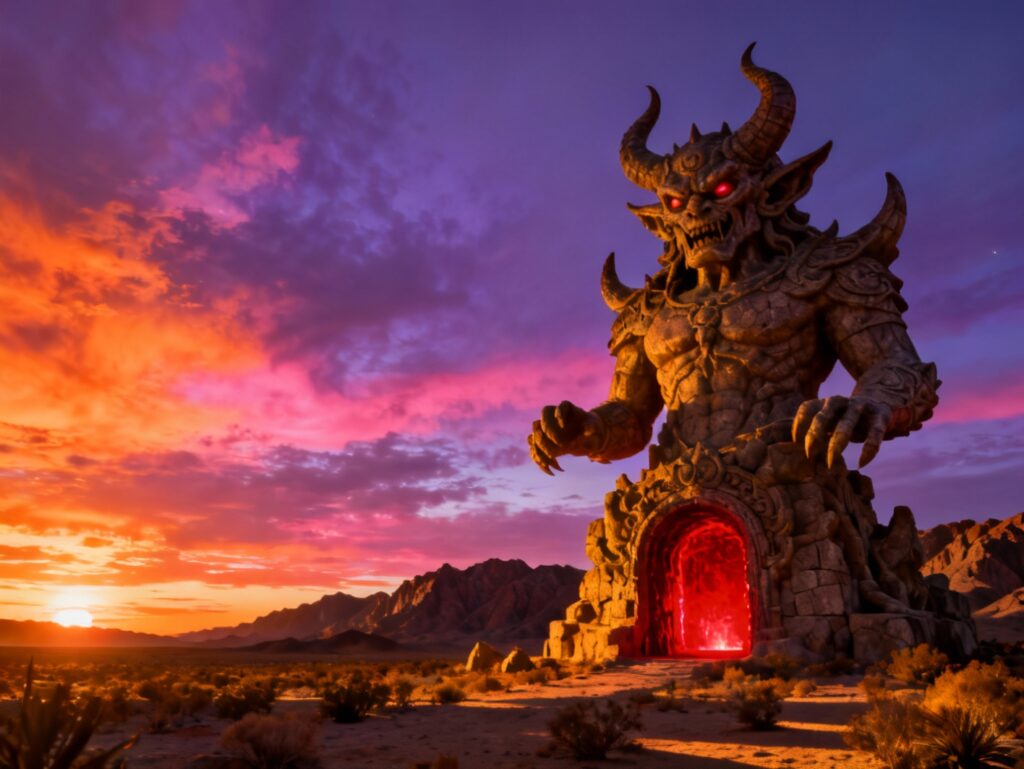
What met the first fans who arrived at the coordinates was nothing short of surreal. Towering over the sand stood a stark and menacing statue, nearly 20 feet tall. Its imposing presence was emphasized by the detailed engravings covering its surface—images of skeletons, grotesque demons, and arcane symbols adorned every inch. At its center was a circular structure resembling a portal, framed by gnarled stone hands and glowing faintly with a red light that intensified after sundown.
The craftsmanship was unnervingly precise. Each figure carved into the monument seemed to represent a different era of dark fantasy, with visual elements recalling mythological horrors and gothic themes. The red glow from the portal pulsated slowly, giving the impression of a heartbeat—an intentional design or just a clever LED trick? Nobody knew for sure. Witnesses reported a chilling silence around the structure, broken only by the wind brushing across the desert sands.
Videos quickly circulated, and the gaming world exploded with excitement and awe. Some called it a piece of performance art; others believed it was a digital-era monolith announcing a new age of gaming. Regardless of interpretation, the monument’s eerie presence had tapped into something primal, drawing players in like moths to a flame.
Community Theories: Deciphering the Statue’s Origins
As soon as the statue’s images hit online platforms, speculation grew rapidly. What game could inspire such a structure? Fans poured over the statue’s design details, trying to match artistic motifs to beloved franchises. The demonic features led many to theorize a potential Diablo IV expansion announcement. Others highlighted the runic carvings and skeletal motifs as being reminiscent of Elden Ring or The Elder Scrolls.
Intriguingly, some hypothesized that the portal could symbolize a new God of War saga featuring mythologies not yet explored. Another group believed it hinted at a reboot or revival of Castlevania—the gothic tone certainly supported that theory. Yet another took note of the monument’s apocalyptic atmosphere and connected it to rumors of a DOOM: Dark Ages entry, which has been quietly circulating in industry whisper networks.
Industry insiders provided fuel to the discussion. A few hinted at major dark fantasy projects using theatrical teasers to generate early buzz. No official statement has confirmed anything substantial, but the deliberate ambiguity appears to be part of the strategy. Whether it’s a teaser for a familiar world or an entirely new IP, the statue has succeeded in generating a frenzy of community-driven research and debate online.
Marketing Masterstroke: The Impact on The Game Awards Hype
The impact of the statue’s discovery rippled outward fast. Interest in The Game Awards 2025 spiked nearly overnight. Fan discussions, media speculation, and influencer analysis turned Keighley’s cryptic campaign into a viral hit. This wasn’t an ordinary teaser; it was an immersive experience—and the payoff was emotional, social, and incredibly effective.
Marketing campaigns tied to real-world exploration aren’t new, but few have reached this level of engagement. When comparing this to earlier viral stunts like Cyberpunk 2077’s city billboards or Death Stranding’s mysterious trailers, the Mojave statue feels more intimate and participatory. People physically traveled to find it, touching the stone and capturing selfies alongside the sculpture. It’s brought communities together—Reddit threads, podcasts, and YouTube dissections have sprouted up daily since its reveal.
As The Game Awards approach, anticipation isn’t just about the games—it’s about what’s possible. The statue challenged passive fandoms to become active participants. Whether the reveal is a major title announcement or a tech demo showcasing narrative innovation, the mystery surrounding it acts as a primer for the revolutionary storytelling expected at this year’s ceremony.
The Role of Alternate Reality Games (ARGs) in Modern Marketing
The gaming industry has increasingly turned to Alternate Reality Games (ARGs) and real-world installations to enhance marketing campaigns. This trend reflects a broader shift toward immersive storytelling and community engagement. The Mojave Desert statue fits this profile perfectly, merging digital breadcrumb trails with a physical destination in the real world.
In the past, titles like Halo 2’s ‘I Love Bees’ campaign, BioShock 2’s ‘Something in the Sea,’ or Destiny 2’s Whisper mission ARG have shown how effective this format can be. These experiences captured players’ imaginations, driving viral speculation and creating stories before the actual games even launched. ARGs build anticipation in layers, offering puzzles, visual clues, and community cooperation to unlock meaning. The statue’s discovery reflects this design—to participate is to start playing before the game even begins.
Real-world elements create emotional impact, blending fiction with reality. By traveling to a desert, fans feel like they’re part of the story. The statue’s artistic depth and cryptic design amplify this effect, instilling a sense of mythology. Marketing becomes world-building, and each new clue becomes part of the larger narrative tapestry.
Awaiting Revelation: What to Expect at The Game Awards 2025
As speculation intensifies, everyone is asking the same question: What exactly will be revealed at The Game Awards 2025? Theories point in many directions. If the statue is indeed linked to an established franchise, then fans could be looking at an Elden Ring 2 teaser or a Diablo IV expansion focusing on deeper hellish mythology.
Yet, the strongest possibility remains the unveiling of a new dark fantasy IP that utilizes transmedia storytelling from the outset. The portal metaphor at the statue’s center may suggest opening the door to a new game universe—one that encourages community interaction well before launch. With the industry shifting toward experiential storytelling and real-world immersion, this kind of marketing aligns with ongoing trends in AAA development.
The Game Awards 2025 could also become a showcase for how entertainment is merging with physical art and narrative experience. Instead of just celebrating finished games, it’s becoming a platform for interactive reveals and game world extensions. Whatever the announcement may be, this carefully orchestrated mystery ensures that fans will tune in with heightened curiosity and emotional investment.
Conclusions
The emergence of the Mojave Desert statue has done more than just promote an upcoming game—it has reignited the community’s passion for storytelling, mystery, and discovery. By combining cryptic messages, geolocation tools, and physical installations, the campaign has sparked imaginations worldwide. As fans eagerly await The Game Awards 2025, the statue stands as a symbol of what interactive marketing can achieve. Whether it heralds a sequel, expansion, or brand-new fantasy universe, one thing is certain: the future of gaming reveals is more experiential, immersive, and community-driven than ever before.