









Table of Contents
The recent qualification of AIM-NASH by the FDA marks a breakthrough in the use of artificial intelligence in liver disease research and treatment. Specifically designed to assist in evaluating metabolic dysfunction-associated steatohepatitis (MASH), this technology offers a modern solution to long-standing challenges in the field. As MASH continues to rise in global prevalence, effective diagnostic and therapeutic strategies are needed more than ever. Traditional methods have struggled with consistency, speed, and subjectivity, particularly in clinical trials where precision is crucial. Introducing AI into the process not only promises to enhance how liver disease is understood and managed, but also demonstrates a broader step forward for AI’s integration into healthcare. In this article, we examine what MASH is, explore the development and qualification of AIM-NASH, and consider the wider potential of AI tools in advancing drug development and patient care.
Understanding MASH and Its Clinical Challenges
Metabolic dysfunction-associated steatohepatitis, or MASH, is a progressive liver disease resulting from fat accumulation in liver cells. It leads to inflammation and fibrosis, and can progress to cirrhosis or liver cancer. It’s an advanced form of metabolic dysfunction-associated steatotic liver disease (MASLD), affecting millions worldwide, especially among individuals with obesity, type 2 diabetes, or metabolic syndrome.
Diagnosing MASH remains difficult because early symptoms are often nonexistent or non-specific. The current gold standard is liver biopsy, which is invasive, expensive, and prone to variability due to human interpretation. In clinical trials, this variability can affect drug evaluation accuracy and delay development.
There’s a growing need for more efficient, reproducible, and standardized diagnostic tools. As investigational treatments for MASH progress through clinical testing, consistent measurement of liver tissue changes is essential for determining efficacy. However, manual evaluation by pathologists is time-consuming and subjective. This creates bottlenecks in trials and increases costs. Due to these challenges, researchers are exploring innovative technologies, including AI, to improve diagnostic consistency and speed, foster better patient selection, and enhance endpoint validation. The FDA’s focus on supporting such innovations signals a shift toward a more data-driven, tech-enabled future in hepatology.
Introducing AIM-NASH: The AI Breakthrough
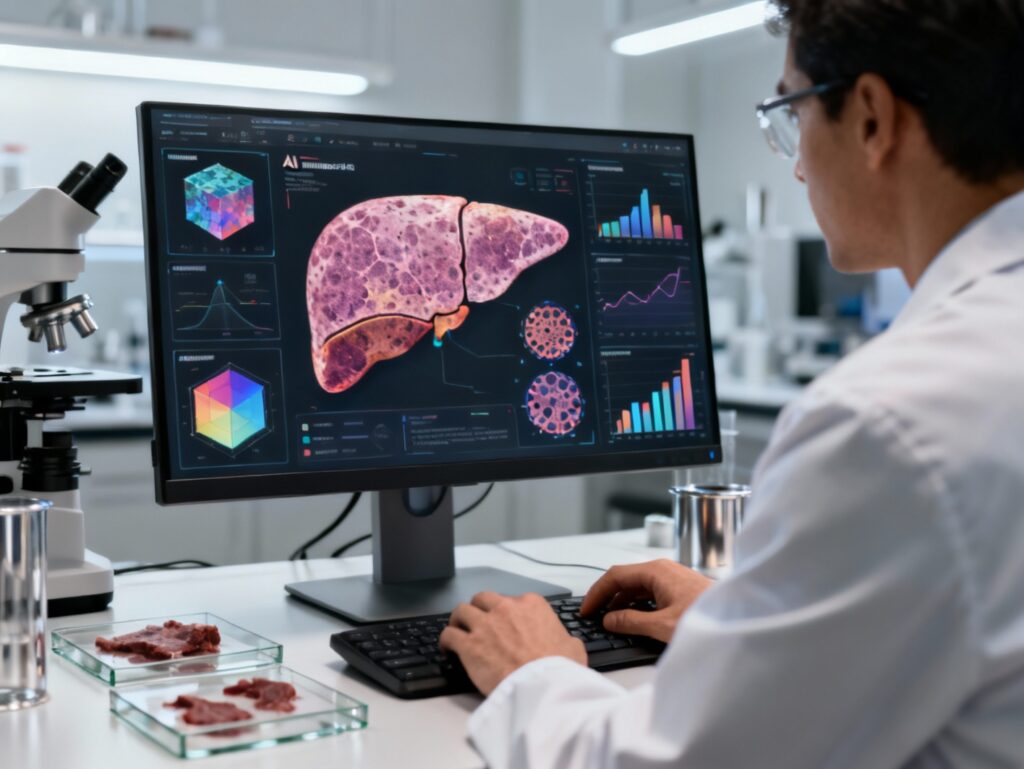
AIM-NASH is a novel artificial intelligence tool developed to assist in the diagnosis and monitoring of MASH through automated image analysis of liver biopsies. Recently qualified by the FDA, AIM-NASH is designed to standardize how key histological features—steatosis (fat buildup), inflammation, hepatocyte ballooning, and fibrosis (scarring)—are assessed.
Developed using machine learning algorithms trained on thousands of annotated tissue samples, AIM-NASH processes high-resolution digital images of liver biopsies. It identifies and quantifies disease indicators with greater consistency and detail than most manual methods. This enhanced interpretability is essential in clinical trials, where precise and reproducible measurements are needed to assess drug efficacy.
What sets AIM-NASH apart is its ability to deliver standardized outputs based on established scoring systems. Researchers and clinicians can now rely on uniform data across multiple sites and trials. The software integrates seamlessly into digital pathology workflows, analyzing tissue images and returning structured, quantitative outputs without human bias.
Through this approach, AIM-NASH expedites the review process, potentially reducing the time and cost of clinical trials. Its use offers a pathway to early detection of histological changes that might otherwise be missed or misclassified using human interpretation alone. By replacing subjective evaluations with data-driven insights, AIM-NASH has the potential to reshape how liver diseases like MASH are studied and treated.
FDA’s Qualification and Its Significance
The FDA qualification of AIM-NASH as a Drug Development Tool represents a critical regulatory milestone. This process involved rigorous validation studies to demonstrate that AIM-NASH’s automated assessments were comparable to expert pathologist evaluations—not just in accuracy, but in clinical relevance. These studies relied on blinded comparisons using liver biopsy slides assessed both manually and by the AI tool.
During qualification, data from multiple independent clinical trials were used to benchmark AIM-NASH’s consistency in scoring key features like fibrosis and steatosis. The studies showed that AIM-NASH not only matched pathologist consensus in identifying disease severity but also reduced variability between different sites and readers.
The qualification process required evidence that AIM-NASH could reliably detect treatment-related changes in liver histology over time. As a result, the FDA now recognizes AIM-NASH as an acceptable method for evaluating imaging endpoints in MASH drug trials. It’s the first AI-based tool permitted for this type of usage, signifying growing trust in technology’s role in clinical research.
This decision sets a precedent, reflecting the regulator’s willingness to embrace AI when it’s supported by solid science. The impact is profound: pharmaceutical companies can now implement AIM-NASH in studies with confidence that its outputs will meet regulatory scrutiny. More broadly, it signals a shift in clinical trial methodology, where technology and medicine converge to improve research efficiency and outcome reliability.
Comparing Traditional and AI-Enhanced Assessments
Traditionally, liver biopsy evaluation relies on manual interpretation by several expert pathologists to ensure accuracy and consensus. This process, however, introduces several challenges. Manual evaluations are time-intensive and subject to human bias, with variability in scoring depending on the individual’s training and fatigue levels. To compensate, multiple reviewers are needed, further slowing down the process and increasing costs.
In contrast, AIM-NASH offers a scalable, automated approach to liver biopsy analysis. It can process digital biopsy images rapidly, analyzing thousands of tissue samples consistently and delivering quantitative data across key MASH criteria. This eliminates the need for repeated review by humans and allows for faster decision-making in clinical trials.
One major advantage of AIM-NASH is its inter-rater reliability. While human experts might disagree on fibrosis stages, AIM-NASH delivers uniform results regardless of time or operator. This uniformity reduces discrepancies that could otherwise lead to misinterpretation of a treatment’s effect.
Additionally, the AI system lowers the resource demand of trials. Smaller pathology teams can manage larger study populations with high throughput. This efficiency helps shorten the overall drug development timeline and can accelerate the journey from trial to treatment.
The shift toward AI evaluation isn’t just about replacing human effort, but rather enhancing it. By removing repetitive tasks and improving accuracy, AIM-NASH allows humans to focus on more complex clinical decisions. This synergy marks an evolution in how trials are conducted and assessed.
Broader Implications for AI in Drug Development
With the qualification of AIM-NASH, the pharmaceutical industry gains a powerful tool that could significantly alter the economics and logistics of drug development. By reducing variability in histological assessments, AI platforms like AIM-NASH can improve decision-making at key development stages, from patient recruitment to endpoint validation.
Clinical trials for MASH are costly and often prolonged due to the need for subjective biopsy review and slow enrollment tied to uncertainty in disease staging. AIM-NASH provides clarity and real-time, reproducible data, helping researchers more accurately select trial participants and assess drug efficacy. This translates into fewer patient dropouts, reduced protocol amendments, and better-targeted therapies.
On a larger scale, pharmaceutical companies can benefit from decreased overall development expenses. AI allows faster turnaround and increases confidence in study outcomes, potentially shortening time to market. For MASH, where no FDA-approved pharmacologic therapy currently exists, this is a vital advantage.
Beyond liver disease, AIM-NASH’s success paves the way for similar tools in cardiovascular disease, oncology, and neurology. As companies understand AI’s capacity for improving data reliability, they may adopt AI-enabled endpoints more broadly. This could trigger a shift in clinical operations toward more digitized, automated, and scalable infrastructures.
Rather than replacing human expertise, AI enhances it—offering pharmaceutical teams the ability to make faster, more reliable decisions. As more tools like AIM-NASH receive regulatory support, the path to faster, more efficient drug development becomes increasingly achievable.
Future Prospects and Ethical Considerations
Looking ahead, the incorporation of AI tools like AIM-NASH into medical diagnostics and drug development marks only the beginning. Advances in machine learning, computational pathology, and big data analytics will continue to refine how we detect disease and measure treatment impact across medical disciplines.
AI systems will likely become embedded in clinical decision support, enabling real-time insights during diagnosis and therapy monitoring. In the future, AI may even predict disease progression before conventional imaging can detect it. Such predictive capabilities could dramatically change how diseases like MASH are managed.
However, increasing reliance on AI introduces ethical and operational questions. Accuracy and transparency remain paramount. To maintain trust, AI algorithms must be auditable and explainable, so clinicians understand how outputs are generated. Clinical users must receive adequate training to interpret AI-derived insights responsibly.
Data privacy is another concern. Large datasets used to train AI models must be handled with care, respecting patient confidentiality and conforming to international data governance standards. Regulatory frameworks will also need to evolve to keep pace with innovation while protecting patient rights.
Ultimately, integrating AI into medicine requires a balanced approach—leveraging its efficiency and precision while ensuring oversight, accountability, and equity. With appropriate safeguards, AI could revolutionize diagnostics and therapeutics, reducing health care burdens and improving outcomes around the world.
Conclusions
The FDA’s qualification of AIM-NASH reflects a broader transformation in modern medicine, where AI is starting to play a central role in clinical research and diagnostics. Specifically, AIM-NASH has shown how artificial intelligence can streamline complex processes, such as liver biopsy interpretation, helping accelerate MASH drug development. Tools like this not only enhance consistency and speed but also reduce costs and open the door to more scalable studies. As this innovation gains traction, it reminds us that technology and medicine must evolve in tandem. To truly benefit from AI’s potential, its integration must be guided by ethical standards, clinical oversight, and a commitment to patient welfare. The future of medicine is undeniably smarter, and the story of AIM-NASH is just the beginning of what’s possible when data science and healthcare unite.