







Table of Contents
- Introduction
- The Role of AI in Modern Astronomy
- Discovery of SN 2023zkd: A Collaborative Effort
- Unraveling the Unusual Behavior of SN 2023zkd
- The Black Hole Connection: A Star’s Fatal Encounter
- Implications for Stellar Evolution and Supernova Classification
- Future Prospects: AI and the Next Generation of Astronomical Discoveries
- Conclusions
In a recent astronomical breakthrough, scientists have unearthed a rare and intriguing kind of stellar explosion named SN 2023zkd. This supernova presents unique characteristics that defy conventional models, involving a massive star in a tight interaction with a black hole. What makes this discovery even more remarkable is that it was detected and analyzed with the help of artificial intelligence. AI is rapidly transforming the way astronomers study the cosmos, enabling faster and more detailed understanding of rare phenomena. By processing immense datasets from sky surveys with unprecedented speed, AI algorithms are now instrumental in identifying anomalies that human researchers might miss. This synergy between human expertise and machine learning is opening new chapters in our exploration of the universe. In this article, we delve into how AI is reshaping astronomy, the collaborative work behind discovering SN 2023zkd, and how this peculiar supernova challenges our understanding of stellar death.
The Role of AI in Modern Astronomy
In the modern era of astronomy, artificial intelligence has become an essential tool for exploring the vastness of space. Traditional methods of identifying cosmic events like supernovae involved manual sifting through massive datasets—an approach that is no longer feasible as telescopes generate terabytes of data every night.
AI has revolutionized this process by automating data analysis and distinguishing meaningful signals from noise. Machine learning models, particularly convolutional neural networks, are now trained on historical astronomical imagery to spot subtle changes that signify new or unusual events. These algorithms pinpoint potential supernovae, gravitational lensing events, and other cosmic occurrences that might otherwise be overlooked.
In the realm of transient events, where timing is crucial, AI offers a real-time solution. Algorithms can detect sudden brightening in the sky and alert astronomers almost instantaneously. This capability improves follow-up observations, enabling in-depth studies of ephemeral cosmic phenomena.
More significantly, AI aids in the classification of supernovae by comparing light curves and spectra to known events. This not only accelerates research but also reveals cases that deviate from existing categories, pushing the boundaries of our astrophysical models.
Discovery of SN 2023zkd: A Collaborative Effort
The discovery of SN 2023zkd was made possible through the collaboration between the Center for Astrophysics | Harvard & Smithsonian and the Massachusetts Institute of Technology, both central players in the Young Supernova Experiment (YSE). This project aims to systematically identify and study supernovae in their early stages, allowing scientists to understand the mechanisms leading to stellar death.
YSE uses cutting-edge telescopes equipped with wide-field cameras to scan the sky every few nights. Over time, this data builds a timeline of transient events, capturing their emergence and evolution. It was within this immense dataset that AI algorithms flagged an unusual occurrence—a light curve that didn’t match any known supernova profiles.
After the AI model highlighted SN 2023zkd as an anomaly, human researchers dove deeper. What stood out was the object’s initial brightening and unexpected long-term activity, which spurred intensified monitoring. The coordination between institutions played a crucial role in confirming and analyzing the event. Rapid communication of findings between MIT, CfA, and follow-up observatories around the globe helped construct a detailed temporal and spectral profile of the supernova.
This close integration of AI-driven detection and multi-institutional expertise exemplifies how large-scale scientific collaborations can adapt to leverage machine learning tools, reshaping how astronomical phenomena are discovered and studied.
Unraveling the Unusual Behavior of SN 2023zkd
SN 2023zkd quickly distinguished itself from typical stellar explosions. While most supernovae experience a sharp rise and a gradual fading, this event displayed a unique light curve. It began with a sudden brightening—consistent with a supernova’s shock breakout—but what followed was far from ordinary.
Shortly after its initial peak, SN 2023zkd dimmed slightly, only to surprise astronomers with an unexpected re-brightening phase. This secondary increase in luminosity persisted longer than any known comparative supernova. Tied to that, archival data revealed that the progenitor star had demonstrated intense variability in the four years leading up to the explosion.
This long pre-explosion activity—consisting of erratic outbursts and enhanced brightness—was rarely observed in previous supernova progenitors. It indicated ongoing instability, possibly linked to interactions with a gravitational companion or internal core processes near collapse. Furthermore, the presence of specific spectral lines early in the event suggested the star had ejected material even before the final blow, creating a complex circumstellar environment that influenced the explosion’s visual and chemical signatures.
This combination of phenomena challenges existing expectations of stellar behavior before death. Most models don’t anticipate years-long variability in massive stars before detonation, pointing to unknown physics or external influences at work within SN 2023zkd’s progenitor system.
The Black Hole Connection: A Star’s Fatal Encounter
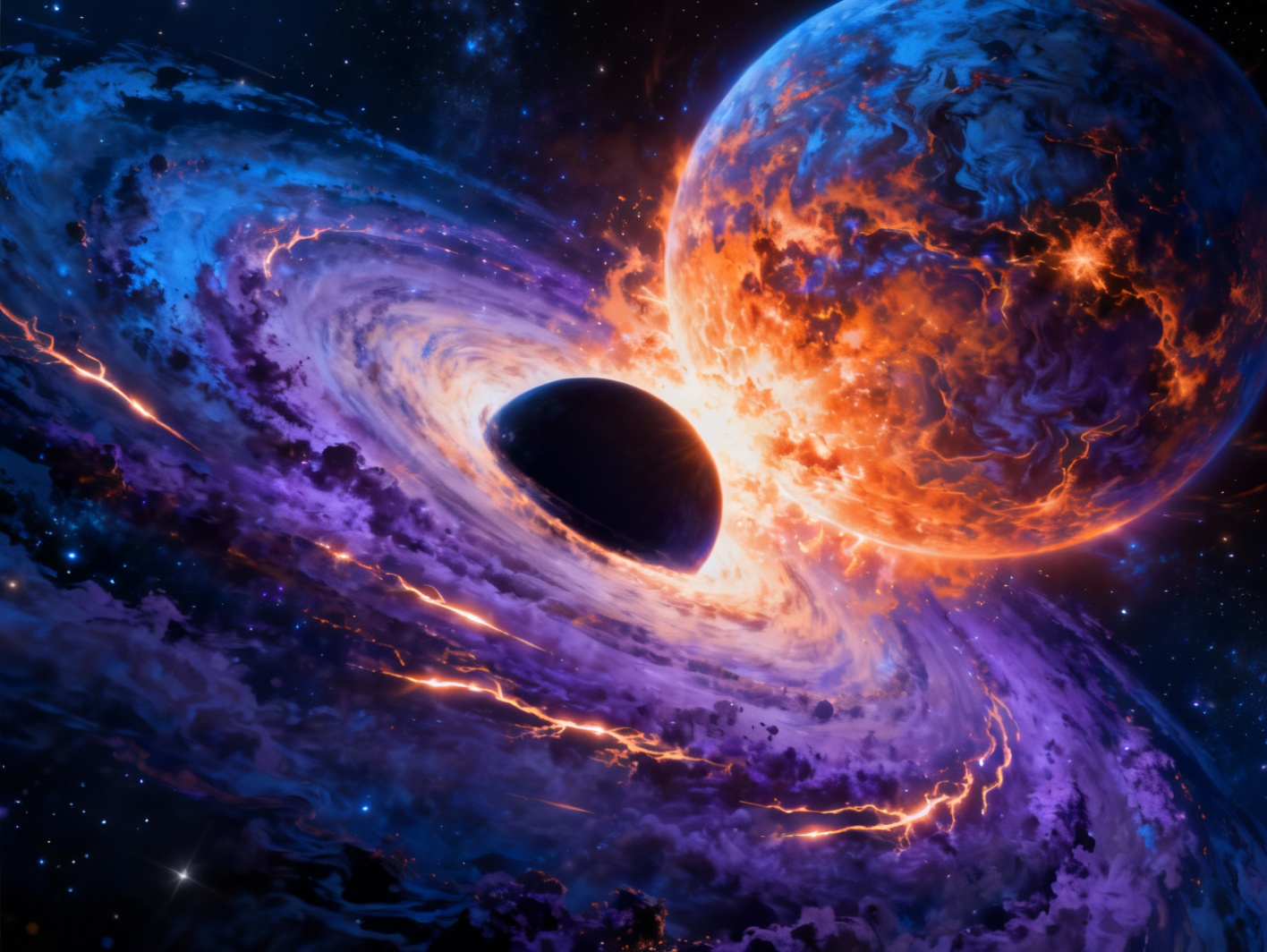
The extraordinary behavior of SN 2023zkd has led researchers to propose an unconventional origin: a massive star closely orbiting a black hole. This binary configuration is theorized to exert intense gravitational stress on the star, causing structural instabilities and enhanced mass loss in the years leading up to its explosion.
The theory is grounded in the gravitational dynamics of tight binary systems. A black hole companion can distort a star’s shape through tidal forces, promoting mass transfer and pulsational shedding of the outer layers. Over time, this interaction saps the star’s equilibrium, hastening core collapse even without exhausting nuclear fuel. Such extreme conditions might trigger both the prolonged pre-explosion activity and the irregular brightening patterns witnessed in SN 2023zkd.
However, alternative theories remain viable. One considers the extreme pre-supernova behavior as internally driven: intense convective processes or shell burning instabilities within massive stars could explain the multi-year variability. Another posits external collisions with a dense circumstellar medium, which would re-energize the shock and cause unusual light curves.
Yet, the binary black hole model stands out as the most cohesive. It explains the tight timeline, the prolonged brightness, and the abnormal pre-collapse phases. If correct, it would mark the strongest observational evidence of black hole-star companions significantly altering stellar death pathways.
Implications for Stellar Evolution and Supernova Classification
The case of SN 2023zkd is more than a singular discovery—it’s a challenge to existing stellar evolution theories. Standard models of supernova types categorize them based on progenitor mass, chemical composition, and internal processes, largely neglecting external gravitational influences like those from black hole companions.
Traditionally, binary interactions were considered mainly for certain supernova types such as Type Ia, where white dwarf binaries play a clear role. But SN 2023zkd, a core-collapse supernova, suggests binaries may have a much broader influence on stellar deaths. From inducing premature collapse to modifying pre-explosion mass loss through tidal stripping, binary systems may define a spectrum of supernova behaviors that classic models don’t anticipate.
Moreover, the variable light curve and the re-brightening observed in SN 2023zkd don’t align neatly with any established supernova classification. This forces astronomers to reevaluate assumptions about light curve evolution, mass ejection dynamics, and the role of circumstellar environments.
These insights are already fueling theoretical revisions and simulations that incorporate gravitational companions and their potential impacts. As more unusual events like SN 2023zkd are identified and confirmed, the classification system of supernovae may need to shift from a progenitor-centric model to one that integrates external interactions as key parameters in stellar collapse.
Future Prospects: AI and the Next Generation of Astronomical Discoveries
Looking ahead, the intersection of AI and astronomy is set to become even more powerful. With next-generation observatories like the Vera C. Rubin Observatory poised to survey the entire sky in unprecedented detail, astronomers anticipate an overwhelming flood of data—far beyond human capacity to process alone.
AI will be essential to navigate this data-rich environment. Advanced deep learning systems will not only identify phenomena faster but also predict potential events through pattern recognition and anomaly detection. By learning from multiband photometric data and spectroscopic signatures, these systems can pre-classify new objects and trigger automated follow-up observations within minutes.
AI’s role will extend beyond detection. Models capable of simulating light curves or reconstructing 3D environmental conditions will offer new insights into supernova mechanisms and progenitor environments. Reinforcement learning could guide telescope networks to optimize observation scheduling, ensuring resources are allocated to the most scientifically interesting events.
Importantly, AI will democratize discovery—enabling smaller institutions to participate in frontier science through open-source tools and shared models. With SN 2023zkd as an example, the future holds the promise of uncovering more such unpredictable cosmic events, reshaping the boundaries of what we can learn about stellar life, death, and the violent processes in between.
Conclusions
The revelation of SN 2023zkd is a testament to the profound impact that artificial intelligence is having on astronomy. Not only did AI enable the rapid detection of a highly unusual supernova, but it also helped researchers recognize the unique cosmic narrative unfolding from a massive star wrestling with the gravity of a nearby black hole. This discovery sends ripples through long-standing models of stellar death, challenging assumptions and paving new theoretical paths.
More broadly, it illustrates how machine learning can work in concert with human ingenuity to uncover the universe’s hidden stories. As future observatories and expansive sky surveys come online, AI will become not just a helpful asset but a critical partner in decoding the cosmos. The trailblazing findings from SN 2023zkd signal the beginning of a new era, where our expanding digital tools empower us to question, redefine, and deepen our understanding of how stars live and die.