






Table of Contents
- Introduction
- Understanding Tropospheric Delay and Its Impact on Astronomy
- Traditional Methods of Atmospheric Calibration
- Introduction to AI in Atmospheric Calibration
- Case Study: The NanShan 26-Meter Radio Telescope
- Results and Performance Metrics
- Broader Implications and Future Prospects
- Conclusions
Recent progress in artificial intelligence has revolutionized the way we approach atmospheric calibration in astronomical research. One of the most persistent sources of error in high-precision measurements is tropospheric delay, a phenomenon where electromagnetic waves slow down as they pass through the Earth’s lower atmosphere. This delay can significantly distort data in technologies like Very Long Baseline Interferometry (VLBI) and Global Navigation Satellite Systems (GNSS). Today, AI-driven methods offer a powerful solution to this problem, enabling more precise observations and deeper insights in both geodesy and astronomy. In particular, the development of hybrid deep learning models is transforming how we approach atmospheric prediction, significantly improving accuracy and computational performance.
Understanding Tropospheric Delay and Its Impact on Astronomy
Tropospheric delay occurs when electromagnetic signals from satellites or celestial sources travel through the troposphere, the layer of the atmosphere closest to the Earth’s surface. As these signals pass through regions of varying air pressure, temperature, and especially water vapor content, they slow down. This velocity change introduces a delay known as the zenith tropospheric delay (ZTD), which can affect the accuracy of measurements in systems reliant on time-of-flight calculations.
Two major sources contribute to this delay: the hydrostatic or “dry” component, linked to stable atmospheric gases, and the wet component, caused by water vapor. While the dry delay is relatively predictable, the wet delay is highly variable and difficult to model.
For precise geolocation or astronomical measurements, these delays must be carefully accounted for. In VLBI, even tiny timing inaccuracies can lead to significant phase errors when correlating data from multiple radio telescopes across the globe. Similarly, in GNSS positioning, tropospheric delay can result in errors ranging from several centimeters to more than a meter if uncorrected. Understanding and compensating for these delays is essential for achieving the highest levels of accuracy in space and Earth observations.
Traditional Methods of Atmospheric Calibration
Over the years, several approaches have been developed to model tropospheric delay. One of the most widely used methods involves empirical models that describe average atmospheric behavior based on long-term climatological data. Examples include the Saastamoinen model for delay estimation and the Vienna Mapping Function (VMF), which projects slant delays onto zenith delay values based on elevation angles.
These conventional techniques often rely on a mix of meteorological inputs—such as atmospheric pressure, temperature, and humidity—along with statistical fittings to historical observations. While effective under stable conditions, they are limited in their ability to account for the highly dynamic and nonlinear nature of the atmosphere, particularly in regions with variable weather systems.
Another challenge is the spatial and temporal resolution of these models. They generally assume uniform atmospheric layers and do not adapt quickly to changing conditions. This can introduce substantial errors, especially when dealing with real-time or high-precision applications.
Despite improvements, conventional methods often fall short in predicting the wet delay component accurately due to its erratic behavior. As a result, there’s growing interest in data-driven approaches that can capture complex temporal dependencies and subtle patterns within large volumes of sensor and satellite data.
Introduction to AI in Atmospheric Calibration
With the boom in big data and computational power, artificial intelligence has emerged as a novel approach for predicting atmospheric delays. Of particular interest are hybrid deep learning architectures that combine Gated Recurrent Units (GRU) and Long Short-Term Memory (LSTM) networks—both designed to handle time-series data efficiently.
These models stand out because they excel at capturing both short-term fluctuations and long-term trends in data. LSTM networks are adept at managing long-range dependencies in sequential data, handling vanishing gradients better than traditional neural networks. GRUs, while simpler and computationally lighter, offer similar benefits with fewer parameters.
By combining these two architectures into a hybrid model, researchers are able to leverage the strengths of both systems. The LSTM part handles complex and longer sequences, while the GRU portion provides smoother and faster training processes. The resulting model learns multiscale temporal representations, essential for understanding how atmospheric factors vary over hours, days, and even years.
Such models can process vast GNSS and meteorological datasets to detect patterns invisible to conventional analytical methods. Once trained, they can generate near-instantaneous predictions with impressive accuracy, making them ideal for real-time calibration in scientific instruments. Importantly, this represents a shift from rule-based modeling to data-driven discovery, where the predictive logic evolves from the data itself rather than predefined equations.
Case Study: The NanShan 26-Meter Radio Telescope
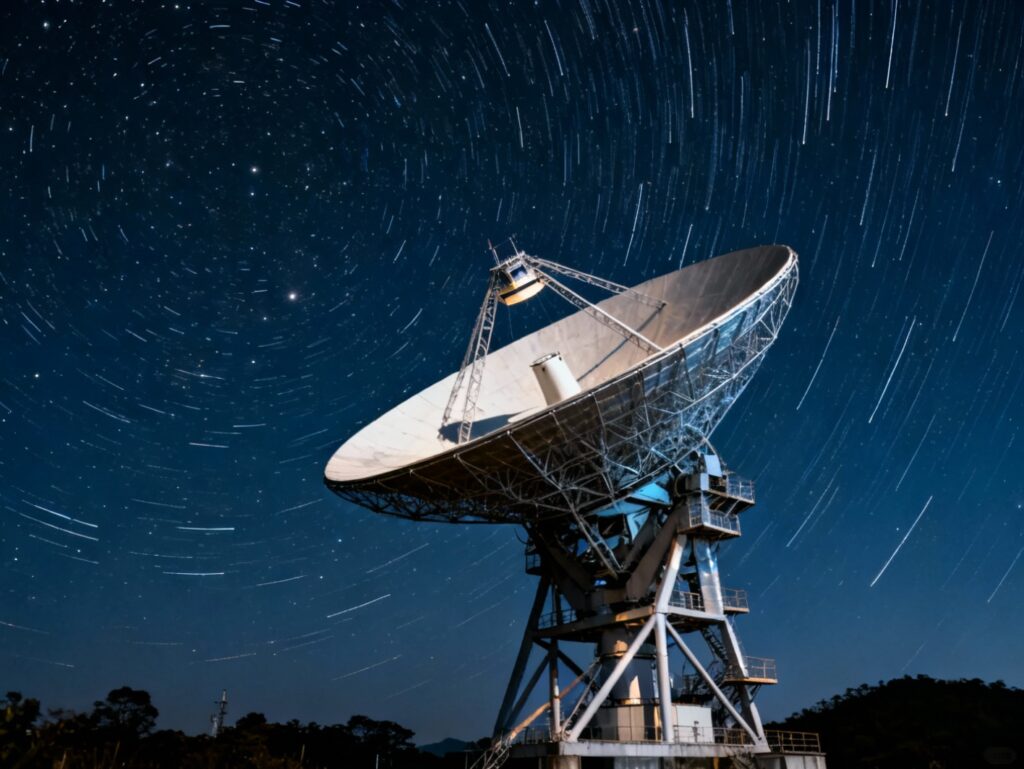
A remarkable example of AI-driven atmospheric calibration is the case study involving the NanShan 26-meter Radio Telescope in China. Researchers targeted the improvement of tropospheric delay prediction by using a hybrid GRU-LSTM model trained on local GNSS and meteorological data collected over several years.
Data included zenith total delay (ZTD) values measured from GNSS stations near the telescope, along with meteorological variables such as temperature, humidity, atmospheric pressure, and wind speed. These inputs were preprocessed to remove anomalies and normalized for consistent scaling across features. The hybrid model’s architecture consisted of alternating GRU and LSTM layers, designed to learn both immediate and cumulative effects of atmospheric changes.
The training process involved feeding time-series segments of input data into the multi-layered model, which gradually updated its internal weights to minimize prediction error. Techniques like dropout regularization and batch normalization were implemented to prevent overfitting. The dataset was divided into training, validation, and test sets, with cross-validation ensuring robust generalization.
This case study effectively demonstrated that with a sufficient quantity of high-quality data and a well-calibrated model, significant improvements in delay prediction can be achieved. The hybrid architecture successfully captured temporal dependencies and identified non-obvious relationships between meteorological parameters and atmospheric delay patterns.
Results and Performance Metrics
The performance of the hybrid GRU-LSTM model was assessed by comparing its predictions of zenith tropospheric delay against observed values. Results showed that the model achieved a mean prediction error of approximately 8 millimeters and a correlation coefficient of 96%, significantly outperforming traditional empirical models in both accuracy and consistency.
Conventional models, while useful under average atmospheric conditions, often show larger errors during periods of rapid weather changes. In contrast, the AI model demonstrated robust performance across a range of meteorological scenarios, including high humidity and fluctuating temperatures. This suggests it is better equipped to account for the notoriously unpredictable wet delay component.
Additionally, the deep learning model required less manual tuning and could adapt over time if retrained with updated data, making it a dynamic tool for long-term observatory operations. Researchers noted a marked improvement in calibration precision, leading to better synchronization in interferometric measurements and more accurate geodetic positioning.
Ultimately, this case confirms the practical utility of AI in a high-demand scientific context. The ability to produce high-fidelity delay estimates in near real-time opens the door for more responsive and precise observational campaigns. The predictive consistency of the model represents a major step forward over traditional methods that often require simplifications or rely on historical averages.
Broader Implications and Future Prospects
The successful integration of AI in modeling tropospheric delay has wide-reaching implications. In millimeter-wave astronomy, where atmospheric delay can drastically affect phase coherence and image quality, accurate real-time calibration is essential. AI-enhanced models can provide continuous updates, reducing the need for frequent observational recalibration and improving telescope efficiency.
Another promising field is weather forecasting. The ability of hybrid deep learning models to learn subtle correlations between meteorological parameters and atmospheric delay also allows them to aid in short-term weather predictions, particularly for localized phenomena. These models can be adapted to integrate with forecasting systems, enhancing resolution and reliability.
In geodetic science, accurate delay correction is vital for tracking tectonic motion and sea-level change. Improved models mean higher precision in GNSS-based measurements, which have broad applications in Earth sciences and civil engineering.
Looking ahead, future research could focus on extending these models to include spatial correlations by incorporating Convolutional Neural Networks (CNNs), or applying transfer learning to adapt models trained at one site for use at other observatories. Collaboration between observatories could also lead to the development of global tropospheric models powered by vast, shared datasets. This convergence of AI and atmospheric science represents the next frontier in observational precision.
Conclusions
The adoption of artificial intelligence in atmospheric calibration represents a transformative leap for astronomy and geodesy. By addressing the complex and nonlinear nature of the troposphere, AI-based models—especially hybrid GRU-LSTM architectures—offer unprecedented levels of accuracy in zenith delay forecasting. These improvements not only benefit radio telescopes and GNSS applications but also pave the way for more precise weather forecasting and Earth monitoring. As this technology evolves, it holds the promise of becoming a standard tool across observatories worldwide, enabling scientists to explore the universe with greater clarity and confidence than ever before.