




Table of Contents
- Introduction
- The Evolution of Coca-Cola’s Holiday Advertising
- Introduction of AI in Coca-Cola’s 2024 Holiday Campaign
- The 2025 AI-Generated Holiday Ads: Content and Execution
- Public and Critical Reception of the 2025 Campaign
- Comparative Analysis: AI in Holiday Advertising Across Brands
- The Future of AI in Advertising: Lessons from Coca-Cola’s Experience
- Conclusions
Coca-Cola recently drew public attention with its newest holiday ad campaigns that were entirely generated using artificial intelligence. Although innovation usually earns praise, this time many consumers were left uncomfortable, describing the ads as cold and soulless. For a brand that has long been associated with warmth and nostalgia during the festive season, this marked a dramatic shift. In this article, we explore Coca-Cola’s rich legacy in holiday advertising, trace its decision to adopt AI, and assess the broader implications of blending tradition with cutting-edge technology in the world of marketing.
The Evolution of Coca-Cola’s Holiday Advertising
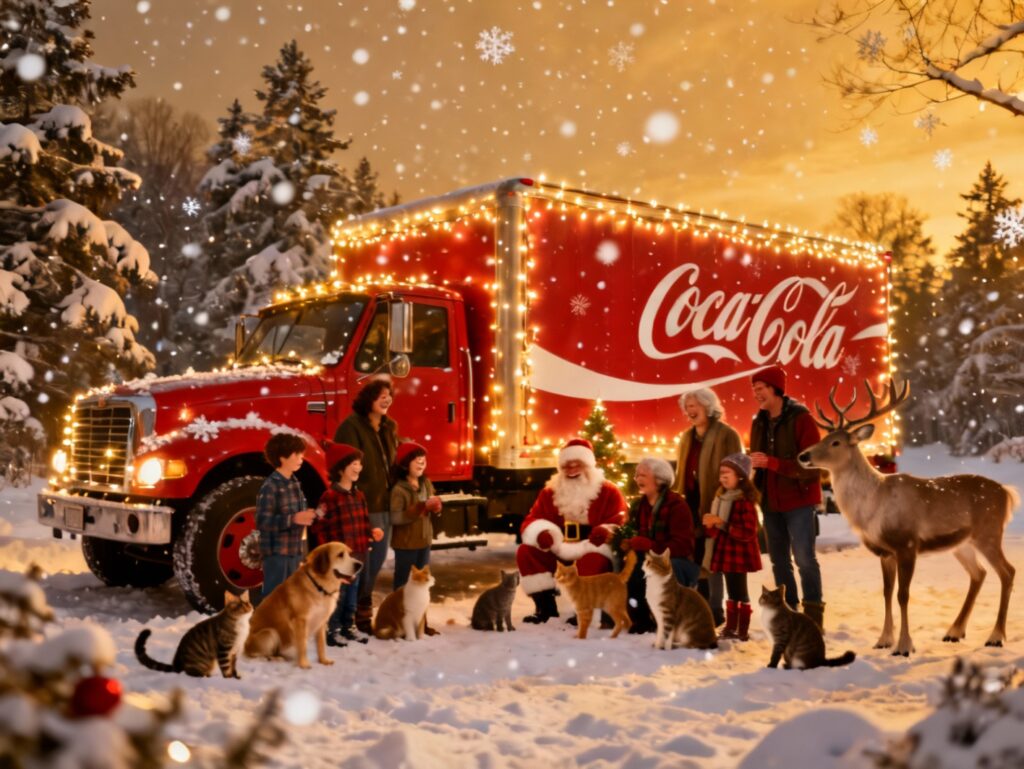
Coca-Cola has always held a special place in holiday advertising, dating back to its iconic 1931 campaign featuring Santa Claus. Created by Haddon Sundblom, this version of Santa—jovial, rosy-cheeked, and dressed in red—reshaped modern perceptions of St. Nick and became synonymous with Christmas cheer. Through the decades, Coca-Cola’s holiday spots centered on themes like family, generosity, and wonder, often paired with warm imagery and classic soundtracks. In the 1990s, the introduction of the Coca-Cola Christmas trucks ignited global excitement, further embedding the brand in end-of-year festivities. These trucks, accompanied by the jingle “Holidays Are Coming,” became an instantly recognizable fixture across television and billboards. What made these campaigns so effective was their emotional resonance. The blend of storytelling, positive imagery, and consistency over years established Coca-Cola as more than just a beverage—it became a holiday companion. The sense of tradition, human connection, and timeless cheer proved to be the formula for unforgettable advertising.
Introduction of AI in Coca-Cola’s 2024 Holiday Campaign
In 2024, Coca-Cola made headlines by integrating artificial intelligence into its holiday ad production, marking a bold departure from traditional methods. The campaign fused AI-generated visuals and copywriting, portraying magical winter scenes with digitally constructed characters celebrating the festive spirit. The company aimed to explore innovation while maintaining brand identity, envisioning AI as a tool to spark imaginative possibilities unsustainable through conventional means. The AI contributed to storyboarding, animation generation, and even regional adaptions of the ads. Coca-Cola’s objective was to deliver a more dynamic and inclusive global message by using machine learning to reflect various cultural nuances. Initially, the move generated curiosity and cautious optimism. While some lauded the brand for embracing groundbreaking technology, others voiced concerns that the charm and emotional depth of human-crafted ads might be lost. Despite strong engagement on digital platforms, critics argued that the campaign felt overly polished and lacked soul. This feedback hinted at the tension between innovation and authenticity that would later define debates on AI in advertising.
The 2025 AI-Generated Holiday Ads: Content and Execution
Coca-Cola doubled down on artificial intelligence for its 2025 holiday campaign, showcasing significant technological advances over the previous year. This time, the company collaborated with AI artists and narrative engines trained on years of consumer behavior data and brand storytelling. The result was a series of visually stunning micro-films packed with vibrant winter scenes, hyper-detailed animations, and universally themed narratives like unity, giving, and kindness. One notable ad centered around a young girl navigating a whimsical snow-covered village guided by AI-crafted creatures symbolizing hope and curiosity. This installment adopted adaptive content, where visuals and dialogues shifted based on regional audience traits, leveraging deep-learning models for personalization. The campaign also incorporated real-time responsiveness, modifying ad sequences depending on the platform and viewer engagement. While the sophistication of the visual storytelling impressed many, some detractors noted a neural monotony—although tailored, the characters still lacked spontaneity often seen in human-created material. Despite these criticisms, the 2025 campaign illustrated how far AI tools had evolved within a year, pushing the boundaries of scalable, personalized content delivery.
Public and Critical Reception of the 2025 Campaign
Public reaction to Coca-Cola’s 2025 AI-generated ad series was more nuanced and polarized compared to the previous year. While tech enthusiasts and younger digital natives appreciated the innovation, a large segment of consumers expressed emotional detachment. Critics described the ads as mechanically beautiful yet emotionally hollow. Many longtime fans of the brand missed familiar elements—namely warmth, subtle humor, and human imperfections—that once made Coca-Cola’s holiday presence feel heartfelt. Social commentary on platforms like Twitter and Reddit frequently lamented the absence of Santa Claus and the iconic Coke trucks in favor of indistinct, unreal characters. On the flip side, praise was given for the campaign’s inclusive representation, with AI generating celebrations that reflected diverse cultures without language or geographic barriers. Marketing analysts noted that while AI helped produce more scalable, multi-market campaigns, it didn’t necessarily deepen emotional resonance. Sentiment analysis revealed a pattern: admiration for the craft, skepticism about the heart. Experts cautioned that while AI could amplify reach and efficiency, it couldn’t replace human creativity and intuition when striving to build emotional connections.
Comparative Analysis: AI in Holiday Advertising Across Brands
Coca-Cola is not alone in exploring AI for holiday campaigns. Other major brands like Pepsi, Amazon, and Nike have also ventured into AI-generated marketing. For example, Amazon’s AI-driven ad in 2024 tailored holiday gift scenes according to regional preferences, which impressed audiences with its customization. Similarly, Nike experimented with AI to animate footwear as characters in a festive storyline, but the campaign fell flat, being labeled gimmicky and confusing. Coca-Cola’s approach differed by anchoring its AI projects in narrative tradition, attempting to balance innovation with brand legacy. However, the fact remains—many AI-driven campaigns struggle when emotional depth and authenticity are required. Across these cases, several success factors have emerged: transparency about AI use, retaining core brand symbols, and using AI to support rather than replace creative storytelling. Failures often arose when technology overtook heart, or the audience wasn’t informed about the creative process. Coca-Cola’s experience, when compared alongside others, reveals that public acceptance of AI in advertising hinges not solely on execution but on the resonance and intent behind the campaign.
The Future of AI in Advertising: Lessons from Coca-Cola’s Experience
Coca-Cola’s bold embrace of AI in holiday advertising offers both a case study and a cautionary tale for the industry. On one hand, AI has shown its ability to capture attention with immersive visuals and flexible narratives tailored to varied audiences. The scalability and speed that machine-generated content brings can’t be ignored, especially for global campaigns. However, the mixed reception underscores a vital principle: emotional relevance matters. Consumers are drawn to authenticity, connection, and tradition—elements that AI still struggles to replicate convincingly. For brands considering AI integration, Coca-Cola’s journey demonstrates the importance of aligning technological innovation with established brand identity. Rather than viewing AI as a total replacement, marketers may use it as a supportive tool to enhance human storytelling. The lesson here is clear: while AI can dazzle, it must work in service of emotional truth. As AI tools evolve, the challenge will remain to keep heart and soul at the center of brand narratives, particularly during seasons defined by sentiment and nostalgia.
Conclusions
Coca-Cola’s foray into AI-generated holiday advertising has illuminated both the potential and pitfalls of using technology in emotionally charged campaigns. While the brand achieved technical breakthroughs and broader audience reach, the absence of human warmth left many viewers unsatisfied. This balance between innovation and emotional resonance is pivotal. Brands eager to adopt AI must reflect deeply on their identity and audience expectations. Coca-Cola’s evolving journey suggests that although AI can enrich storytelling, it must not overshadow the human elements that grant ads their lasting power and meaning.