







Table of Contents
- Introduction
- The Rise of AI Agent Tokens: A New Era in Cryptocurrency
- Memecoins’ Declining Dominance: Understanding the Shift
- Dragonfly Capital’s Forecast: AI Agents Leading the Charge
- Potential Challenges and the Future of AI Agent Tokens
- Investor Implications: Navigating the Changing Crypto Landscape
- Broader Market Impacts: The Ripple Effect of AI Agents’ Ascendancy
- Conclusions
AI agent tokens are poised to redefine the cryptocurrency landscape in 2025. As speculative assets like memecoins begin to fade from the spotlight, utility-focused digital assets anchored in artificial intelligence are capturing investor attention. This transformation is not just a shift in market preference, but a reflection of how technology and value creation are converging in digital markets. Haseeb Qureshi, managing partner at Dragonfly Capital, has voiced conviction that AI agent tokens will outperform memecoins by a large margin, signaling both a technological and financial evolution in crypto. This article dives into what makes AI agent tokens compelling, the forces driving this change, and how investors can strategically respond to this evolving environment.
The Rise of AI Agent Tokens: A New Era in Cryptocurrency
The emergence of AI agent tokens in the cryptocurrency market represents a new phase in asset utility and smart contract innovation. Unlike memecoins, which are primarily driven by hype, internet culture, and community enthusiasm, AI agent tokens are rooted in functional systems. These tokens are typically tied to decentralized applications that leverage artificial intelligence to accomplish complex tasks such as autonomous decision-making, smart automation, and data aggregation.
What makes these tokens appealing is their alignment with real technological value. Investors are beginning to view AI agent tokens as assets with intrinsic utility, supporting services such as decentralized search bots, AI-driven trading strategies, and automated governance tools. This functionality sets them apart from memecoins, which often struggle to move beyond tokenomics and community-driven speculation.
Technological advancements such as scalable neural networks, on-chain AI processing, and layer-2 blockchain solutions have made it feasible to run lightweight AI models within blockchain ecosystems. These improvements reduce the cost and increase the performance of AI agents interacting with smart contracts. The market’s initial response has been enthusiastic, with several tokens gaining traction on major exchanges and developer platforms. As this convergence continues, it’s evident that AI agent tokens are becoming more than just digital assets—they are tools for reshaping how decentralized systems work.
Memecoins’ Declining Dominance: Understanding the Shift
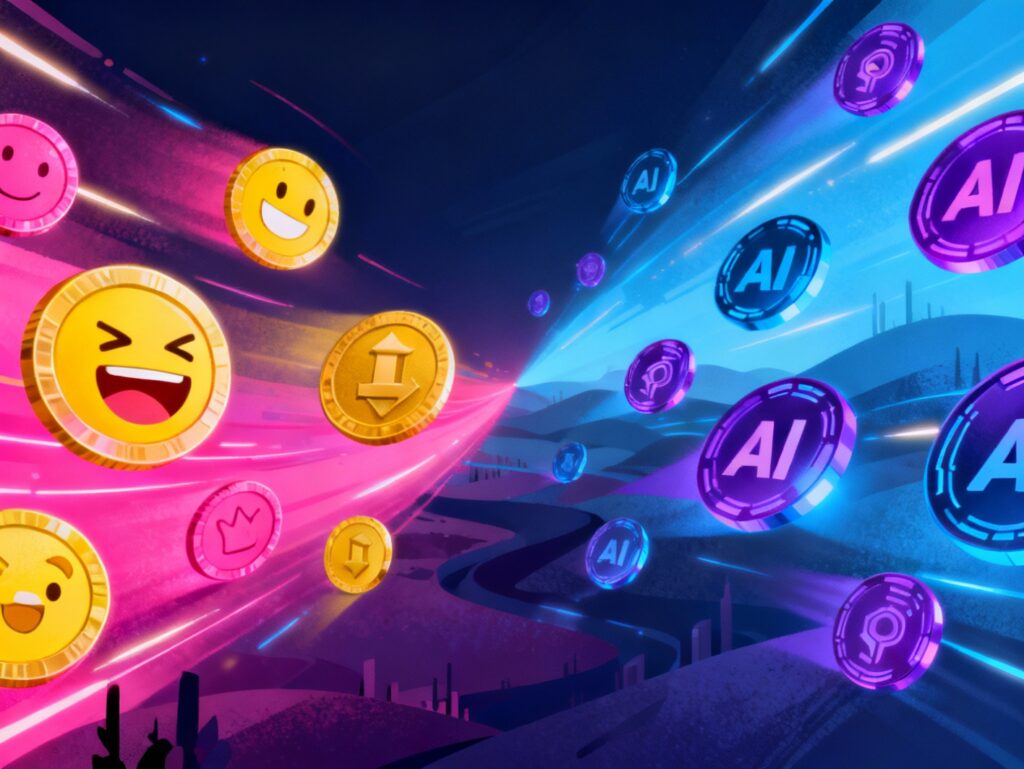
The rise of AI agent tokens has coincided with a noticeable decline in the popularity of memecoins. During the bull runs of previous years, memecoins like Dogecoin and Shiba Inu gained massive popularity due to viral marketing and widespread retail participation. However, recent trends show weakening investor sentiment toward these tokens, largely due to a lack of long-term use cases, market dilution, and high volatility.
One of the key factors contributing to this decline is market saturation. With thousands of memecoins flooding the ecosystem, differentiation has become nearly impossible. Most projects offer nothing beyond a token name, and investors are increasingly questioning the sustainability of purely community-driven speculative assets. At the same time, AI-focused projects are demonstrating tangible advances and delivering platforms with functional AI agents embedded into applications.
According to aggregated market data, memecoin trading volume has dropped by over 60% in the past year, while AI agent tokens show increasing liquidity and participation across decentralized exchanges. Moreover, memecoin market capitalizations are stagnating, whereas AI agent tokens are gaining market share as investors reallocate capital toward innovative and utility-backed assets. This shift reflects a maturing investor base looking beyond memes and toward impactful, scalable technologies.
Dragonfly Capital’s Forecast: AI Agents Leading the Charge
Haseeb Qureshi, a notable voice in the crypto investment world, forecasts that AI agent tokens will lead the next bull cycle in 2025. His belief stems from a combination of macro trends in artificial intelligence development and a growing emphasis on application-layer innovation in cryptocurrency. Qureshi argues that just as Layer 1 blockchains previously unlocked new growth paradigms, now it is tokens rooted in autonomous AI functionality that hold the next value explosion.
According to Qureshi, the sustainability of AI agent tokens hinges on their real-world application. These tokens serve as access interfaces or value units in AI-powered services, offering enhanced user experiences and automation across platforms. With open-source AI models becoming increasingly powerful and accessible, developers can integrate capabilities like dynamic agents into decentralized systems more rapidly than ever before.
However, Qureshi also acknowledges the potential challenges. He notes key risks like the over-financialization of tokens that fail to deliver on AI functionality and the possibility of regulatory bodies stepping in to examine the overlap between AI-driven systems and user data rights. Still, his central thesis remains clear: the convergence of AI and blockchain is not a passing trend but a foundational shift, and AI agent tokens are ideally positioned to dominate this transformation through practical utility and technological relevance.
Potential Challenges and the Future of AI Agent Tokens
While the future of AI agent tokens appears promising, there are several risks and challenges they must overcome to achieve widespread adoption and long-term viability. One major concern is regulatory scrutiny. As AI systems become more autonomous and influential, regulators may treat tokens associated with these systems differently from traditional digital assets, especially if concerns emerge around decision-making accountability or data transparency.
Technological limitations also present hurdles. Running AI agents on-chain is resource-intensive, and while recent innovations have made this more scalable, the complexity of deploying usable models in decentralized environments remains high. Reliability, security, and cost-efficiency are all issues developers need to address to ensure seamless operation. There’s also a risk that overpromising and underdelivering could lead to a similar speculative bubble that plagued memecoins.
Market volatility is another longstanding factor. As prices surge due to investor excitement, AI agent tokens may be exposed to sharp corrections if expectations are not met. Expert opinions are mixed: some see the rise as inevitable given the merging of two powerful tech trends, while others caution against premature optimism without operational proof of concept. In the end, the success of AI agent tokens will depend on continued innovation, market maturity, and responsive adaptation to regulatory and technological shifts.
Investor Implications: Navigating the Changing Crypto Landscape
With the ongoing shift from memecoins to AI agent tokens, investors must adopt new strategies to navigate the evolving crypto landscape. First, understanding the core utility and technological backbone of an AI agent token is essential. Investors should evaluate each token’s underlying AI application, adoption potential, and network effects, rather than chasing hype.
One of the most effective strategies is portfolio diversification. By balancing exposure across proven cryptocurrencies, new AI agent tokens, and infrastructure-layer investments, investors can mitigate the risks associated with volatility and emerging technologies. Diversifying reduces reliance on speculative outcomes and provides exposure to different subsets of crypto innovation.
Risk management is also key. AI tokens might be promising, but they are not immune to scams, pump-and-dump schemes, or technical shortcomings. Conducting due diligence, assessing tokenomics, verifying development teams, and tracking adoption metrics can help avoid common pitfalls. Additionally, allocating capital gradually to emerging AI tokens instead of making concentrated bets can protect against sudden downturns.
As the market evolves, investors should stay informed on regulatory developments, emerging technologies, and macroeconomic factors influencing crypto markets. While the decline of memecoins marks the end of a speculative era, the rise of AI agent tokens ushers in a phase driven by utility, and investors equipped with knowledge and discipline stand the best chance of thriving in this new age.
Broader Market Impacts: The Ripple Effect of AI Agents’ Ascendancy
The rise of AI agent tokens could have far-reaching effects across the broader cryptocurrency ecosystem. One of the most significant impacts may be on the acceleration of decentralization technologies. As demand for AI applications grows, new infrastructure layers will emerge to support more scalable, interoperable, and responsive AI functionalities within blockchains. This could lead to a reshaping of development priorities for smart contract platforms.
Regulatory dynamics may also evolve. The intersection of AI and crypto introduces fresh complexities involving privacy, security, and automated decision-making. Governments and regulatory bodies could introduce stricter requirements for tokens that claim to use AI, potentially establishing standards for transparency and behavior. While this may pose short-term obstacles, it could also pave the way for consumer protection and institutional adoption.
Investor behavior is likely to change. As the narrative shifts towards meaningfully useful tokens, attention might drift away from speculative projects. This could raise the standard of expectations across the crypto sector, reducing capital flow into low-utility tokens and increasing investment in innovation-driven ventures. Furthermore, it may inspire a new generation of entrepreneurs and developers to integrate real AI capabilities into decentralized applications, enhancing overall ecosystem maturity.
Ultimately, the dominance of AI agent tokens signals more than just a sectoral pivot—it reflects a deeper alignment of blockchain with other transformative technologies. This convergence may well reshape how crypto interacts with the broader technological and financial world.
Conclusions
The evolution of AI agent tokens marks a critical turning point in the cryptocurrency sector. From speculative mania to utility-based value, the shift away from memecoins signifies growing expectations around what digital assets should represent. As AI continues to integrate with blockchain, investor interest is increasingly gravitating toward tokens embedded with real functionality and purpose.
While the potential is immense, challenges must not be overlooked—from technological constraints to the need for clear regulatory frameworks. Strategic thinking, informed analysis, and risk-conscious investing will be crucial to navigating this next phase. For those who can recognize and adapt to these evolving dynamics, the rise of AI agent tokens opens doors to a more mature, innovative, and impactful crypto future.